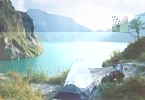
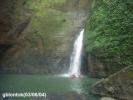
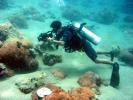
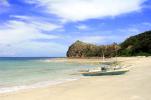
Click on any of the images to see the enlarged copy and narratives of the photo.
Laiya is about 140+km from Manila. It is located on the southeastern tip of
the province of Batangas. It is known for its white beaches, good snorkeling and fishing.
How to go there
There are two routes to choose from when going to Laiya. One is via Lipa, Batangas
and the other is via Candelaria, Quezon. Both routes are nearly equidistant, with the Lipa route
being only about 2km shorter than the Candelaria route. GPS waypoints and track data for both
routes are available from the Downloads page.
Via Candelaria, Quezon: From Manila, take the South Luzon Tollway all the way
to the south end.
At the end of the tollway, take the exit that points to Lucena and simply drive along
this national road until you reach the Sto. Tomas junction. Sto. Tomas has two junctions,
and one of which (the second) does not have any road sign when we passed by.
Anyway, on both juctions, take the road to the left (southeastward) toward
Lucena. This will take you through Alaminos then San Pablo Laguna. At the junction
just before San Pablo, just follow the national road (veering to the right) to bypass
the city proper onward to Tiaong Quezon
then to Candelaria Quezon. At Candelaria, a few meters after the church, turn right
towards San Juan, Batangas. Then, just when you are about to enter the main town of
San Juan, be on the lookout for the road on the left side that has those signs that point
to the numerous beach resorts of Laiya and Hugom. This will be immediately before
the Municipal Hall. You will be turning left, southward. This road will now
bring you through the towns of Ticalan, Abung, Kalubcob and Bataan (all straight southward)
until you reach the point where the road turns westward. At this point, you will see
a lot of beach resort signs along the road. Each of them lead to resorts along the Laiya
shoreline.
Via Lipa, Batangas:
From Manila, take the South Luzon Tollway all the way to the south end.
At the end of the tollway, take the exit that points to Lucena and drive along
this national road until you reach the Calamba boundary.
About 1.5km from the boundary of Calamba, turn right and take the Star
Tollway (Batangas Expressway) up to the Lipa Exit at the end of the tollway.
Upon exit, head eastward towards Lipa.
At Lipa, you are to head for the town of Padre Garcia. This may be easier
said than done however as going through Lipa to go to Padre Garcia may prove to be a challenge.
Lipa has circuitous streets, several one-way streets, and few road signs, so follow
these directions carefully when going through Lipa:
About 1.4km from the Star Tollway exit, you will see the De La Salle Lipa on the left side
of the road. Several meters from De La Salle, there will be a junction. Head straight
east towards Lipa town proper until you see a monument on a Y junction on the right side.
Follow the road as
it merges with the road on the right and immediately keep an eye for Kapitan Luz Street which
is barely a few meters from the monument and turn right at this street, then
turn left at Kalipulako then right at P. Torres. P. Torres street should lead straight out
from Lipa towards Rosario and Padre Garcia.
About 8.5km from Lipa, there will be a junction that leads to Padre Garcia. Turn left
towards Padre Garcia and about 300 meters from the junction (after the market) turn right and head
for San Juan. About 7km down the road to San Juan, there will be a Y junction where
the main road will veer to the left while another road will appear straight ahead.
Follow the road to the left (eastward). Once in San Juan, turn right (southward) on
the road immediately after the San Juan Municipal Hall, this road would have those signs
that point to the numerous beach resorts of Laiya and Hugom. This road will now
bring you through the towns of Ticalan, Abung, Kalubcob and Bataan (all straight southward)
until you reach the point where the road turns westward. At this point, you will see a lot of
beach resort signs along the road. Each of them lead to resorts along the Laiya costline.
Tips
The resorts offer various facilities ranging from
simple beach huts to the most complete (restaurants, first class air conditioned rooms, conference
halls, etc). Take your pick. We suggest you go resort-hopping first before you
settle down on one, as the prices for entrance fees and facility rentals vary extensively.
The Laiya shoreline is quite long. We estimate it to be about
5km (or even more). But what you may want to know is that the eastern half of
the shoreline has different "sand/water" characteristics from the western half.
The eastern half, the half that is roughly 2km before (and up to) Laiya town proper
has very fine sand and the shore slopes very gradually. The very
gradual slope of the shore, the fine sand and the calm water make it an ideal "swimming" area for
people who simply want to enjoy a good swim on a beach.
The very fine sand however, tends to make the water murky (very murky) especially
during high tide.
The western part on the other hand (right after Laiya town and up to Hugom) is for
people who like to go snorkeling, scuba diving or fishing. It has coral reefs and
marine life that could rival what you can experience from the shores of
Anilao.
For those who are interested, a fish sanctuary is located in front of one of the resorts
on the west end (La Luz beach resort). Here, guests can go snorkling and actually see
good marine life from waters barely a meter deep and just 20 meters from shore!
Waypoint narrative by: EPPGarcia 2002 follow EPPGarcia on Facebook
|
|